

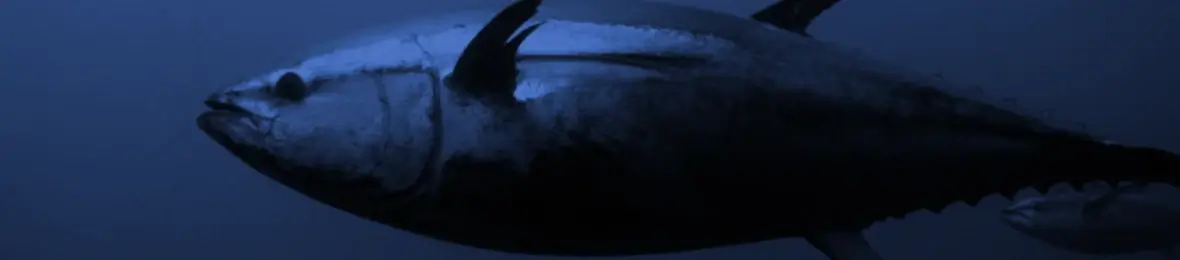

Jigging for Bluefin Tuna
Bluefin tuna are often regarded as one of the most prized sportfish from Maine to North Carolina and afar, providing for unbelievably long battles and excellence as far as table fare. While bluefin tuna are often targeted primarily on the troll and on the chunk, jigging can be an extremely effective technique when the fish are keyed in on a specific area such as a lump, seamount, wreck, or an area that is holding bait consistently. Even intense and consistent boat traffic can drive them down and out of reach of trolled ballyhoo and spreader bars, leaving jigging as the most efficient way to reach them consistently.
As spinning reels have continued to get lighter and stronger, they have been used extensively on fish up to the 200-300lb class, but conventional reels are often the way to go on a larger class of fish. The Shimano Stella 30000SWB and STL20000SWBPG, Daiwa SALTIGA8000HDF, and Van Staal VM275 are all common options for this class of fish that have proven to get the job done. The Shimano Saragosa 20000SW and 25000SW are also solid options for this class of fish if you are looking for a more budget friendly reel. The Shimano Saragosa 10000SW is great for fish up to 150lbs.
Conventional options include the Maxel Ocean Max OM10-OM12 and the Shimano Talica TAC16, TAC16II, and TAC20II. All are best filled with solid Spectra braided line, with 50lb being the minimum breaking strength for the 10000 size reels. 65lb to 80lb and higher is best on the larger 20000 size class reels. Hollow core is also an excellent option so that you can have a spliced loop at the end of your mainline. This will allow you to quickly swap out leaders via a loop to loop connection after a taxing battle with a big bluefin that may have compromised the leader. 60lb and 80lb Jerry Brown would be the best option if you plan to go this route, with the 60lb generally breaking around 90lb and the 80lb generally breaking over 100lbs of pressure.
When looking for the best bluefin tuna jigging rods, you will be hard pressed to find any better than a Black Hole Cape Cod Special without going the custom route. An acid wrapped rod is going to be ideal if going the conventional route, which will help to prevent the rod from rolling over in your wrists and allowing you to put more pressure on the fish rather than worrying about what’s going on with your rod. Other great options include the OTI Fathom Blade Jigging Rods, Phenix Megalodon, and Van Staal Spinning Jig Rods.
Whether you plan on using solid or hollow core braid, the use of a windon leader will prove to be extremely useful. You can either splice a loop into your hollow core line, or form a double line with a Bimini Twist, allowing you to swap out windon leaders after lengthy battles with a bruising bluefin or simply dropping or jumping up a leader breaking strength depending on the day’s conditions. Fluorocarbon leader offers added abrasion resistance and happens to be less visible underwater than traditional monofilament leader material.
From here you can crimp or tie directly to a solid ring with an assist hook and split ring attached. All you will need to do is attach your favorite jig with a good pair of split ring pliers onto the split ring and you are ready to jig. Rigging this way allows you to quickly swap out jigs rather than having hardware attached to each jig you have in your bag. This will also protect your rod when you are moving between spots, by preventing the jig from swinging around and damaging the blank of your rod.
The best bluefin tuna jigs are often representative of their favorite meals, sandeels, ocean herring, and more. Great options include the Shimano Butterfly and Flat Fall Jigs, OTI Jager Jigs, Point Jude Deep Force Jigs, and Hammered Diamond Jigs. Usually a good idea to upgrade the assist hook you use to Owner Monster Jig Hooks and OTI Raptor Assist Hooks. Not a bad idea to pick up a TackleDirect or OTI Jig Bag to organize all of your jigs as well.