
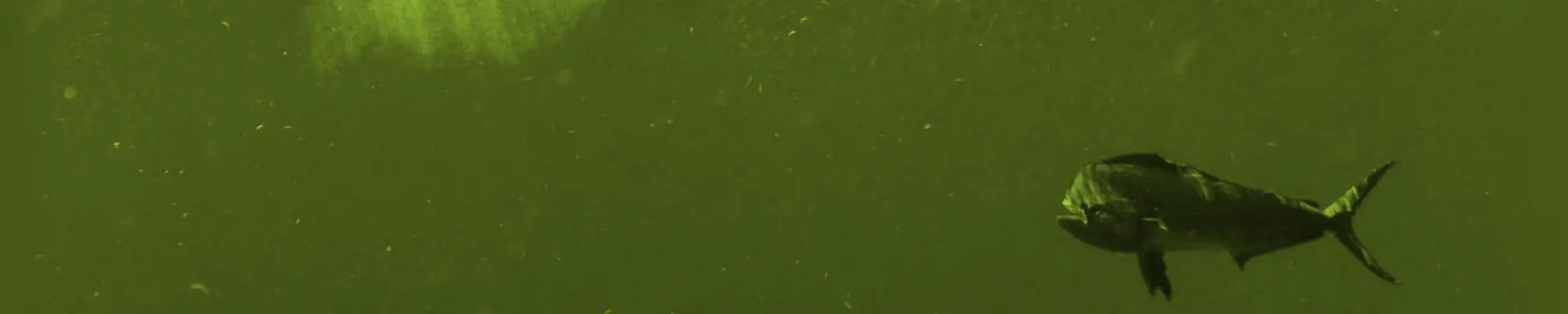
Trolling for Dolphin (Mahi Mahi)
Dolphin, also known as mahi mahi or dorado, happen to be one of the most common catches on the offshore grounds, and prized for their respectable table fare. It is not uncommon to really put together an impressive catch on the troll, starting in the spring and through the warm summer months off of the east coast as they migrate northward towards the midatlantic. They can be targeted several ways, but on the troll often produces the big ones. Usually best to start around sharp temperature breaks, drop offs, lumps, and especially any floating debris. Often times trolling past a floating tree, bucket, or weedline will reward you with a screaming drag.
To get set up for dolphin on the troll, you will want 30lb class and lighter rod/reel combos, as 50lb and 80lb gear are going to be overkill even for the largest mahi you will find out on the rip. A good place to start when looking for the best dolphin trolling reels is the Shimano Talica 20II and Talica 25II. Essentially the same reel, however the TAC25II has a slightly wider spool to accommodate a greater amount of line capacity. If you are using hollow core or solid braid with a mono topshot, the TAC20II will be the perfect option, while the Talica 25 is best if you prefer a long monofilament topshot. Other options include the Accurate BV2-800 and BX2-30, Avet LX and EX 30/2, and the Penn 16VISX, 20VISX, and 30VISX.
The best mahi rods will complement the lighter reels on the market today, and most prefer all open turbo guides that are braid ready, slick butt or Afto aluminum unibutt, and anywhere from a 20-40 to 30-80 monofilament line rating. TackleDirect’s Platinum Hook Conventional Series Rods are perfect for dolphin trolling, with the two best models being the TDPS602030SIN and TDPS603050SIN. Other options include the Shimano Tallus Stand Up Ring Guide Rods, Crowder E Series, Blackfin Standup Trolling Rods, and the TackleDirect Silver Hook Conventional Standup Rods. All will complement the above reels extremely well, resulting in a super light weight setup that will whoop up on stud dolphin.
Most anglers are now gravitating towards using braided line backing, either hollow core or solid, with a monofilament topshot. Hollow core is ideal when using topshots since you can utilize a knotless connection that will smoothly transition through your rod’s guides. While it is slightly thicker and eats up some line capacity, not losing fish to a knot getting caught in a guide is worth it. 60 and 80lb Jerry Brown, Power Pro Hollow, and Cortland C-16 are the most popular options. If you want to stay with solid Spectra, Power Pro Maxcuatro, Sufix 832, and Momoi Diamond Braid are solid options. The Maxcuatro braid is thinner than traditional braided lines of the same breaking strength, which is great for smaller reels where line capacity may be a concern. For the topshot, 40-60lb Momoi Diamond, Ande, and Hi Seas mono are fantastic options, with hi vis yellow allowing you to easily see where each of your lures or baits are within your spread.
When setting up your new dolphin trolling outfits, you will want to tie a Bimini Twist or Spider Hitch at the end of your topshot to form a double line. From here, you can either attach a Momoi wind on leader via a Catspaw loop to loop connection or attach your snap swivel directly to your double line with an offshore loop knot.
A few lures that have proven to be deadly dolphin lures include Zuker Feathers, Sea Stroler Cedar Plugs, Rapala X-Rap Magnums, 1oz Joe Shutes, Bluewater Candy Mini Jags, Ilanders, and Seawitches. Each can be simply attached to your snap swivel for easy changes.
Once you hookup, make sure to stay in gear for as long as you can. Often times dolphin will not be alone, and staying on the troll while fighting the first fish will increase your likelihood of multiple hookups. Also pay attention to the first fish and keep it in the water, as another may be following. Keep a pitch bait rod ready to take advantage, with a light spinning setup often being the easiest to get the job done. Once you have the second fish hooked up you can go ahead and boat the first, and keep repeating this process of keeping one fish in the water as long as there are more following.