Riverbank Stripers
By Frank Ruczynski
Mar 16th 2017
Winter Storm Stella is over and it's time to start thinking about spring stripers!
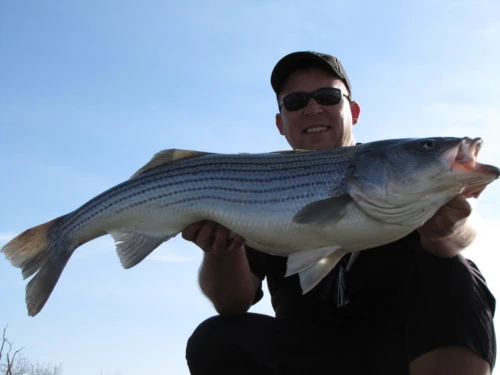
The Delaware River striped bass run may not be what it was a few years ago, but there are still plenty of linesiders around to make the trip worthwhile. Migratory striped bass enter the Delaware Bay in March and make the run up into the freshwater sections of the river through the month of April.
Fishing techniques vary depending on which section of the "Big D" you're fishing. In this entry, we'll concentrate on Salem County, New Jersey – south of the Salem River. This portion of the Delaware River, south of the Salem River, is considered saline so a freshwater fishing license is not needed, there is no requirement of circle hooks and the April 1 to May 31 closed season is only for anglers fishing north of the Salem River up to the Trenton Falls. New Jersey state regulations allow for one striped bass over 28 inches to less than 43 inches and one striped bass over 43 inches per day. Please use common sense when targeting breeding striped bass – these fish are migrating into the river to breed and we'd all like to see a healthy striped bass population in the future.
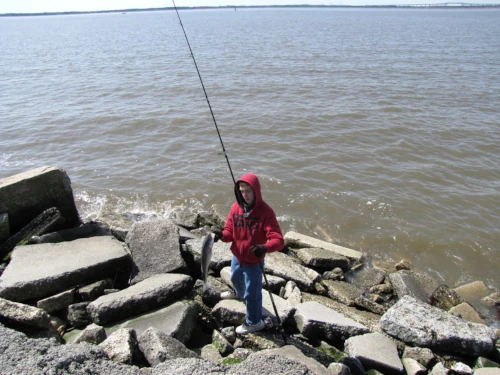
Access points along this stretch of the river are somewhat limited, but the fishing action can be amazing. The resident fish and males seem to be the first to show up on the flats. The smaller striped bass usually become active around March 20, but the bite can vary by a week or so depending on water temperatures. The big girls typically show up in force around April 10. Once word of a bite gets out, just about every access point from Penns Grove to Fortescue will be packed with anglers.
Fishing for striped bass along this stretch of the river isn't complicated. As a matter of fact, it's a lot like fishing for catfish – which you'll also likely encounter. Bloodworms are used almost exclusively and for good reason; I've tried some other baits and nothing else comes close. Casting distance can come into play as this portion of the river is made up of extensive flats. I use a pair of Lamiglas Graphite Surf and Jetty spinning rods: a ten foot XS 10 MHS and an eleven foot XS 11 MS. The extra foot provides a little more casting distance and allows me to stagger my baits without having to think about it. A Shimano Baitrunner D 6000 spinning reel is mounted on my 10' rod and a Shimano Thunnus CI4 6000 spinning reel on my 11' rod. The baitrunner feature works great on both reels, however when using circle hooks I do not engage the baitrunning feature. Both reels are spooled with 20-pound Power Pro Braided Spectra and I use 40-pound Seaguar Fluorocarbon leader material. Some anglers use a top and bottom rig, but I prefer a fish-finder rig. From my experiences catching is about the same, but I use less bait – bloodworms aren't cheap! A Sea Striker Duo-Lock Snap makes a great fish finder slide. Hook selection varies, but most of the time I'm tying on a 5/0 Gamakatsu Octopus circle hook. The current can really get going on this portion of the river so weight selection will fluctuate between 3 and 6 ounces. Sputnik or pyramid sinkers work well.
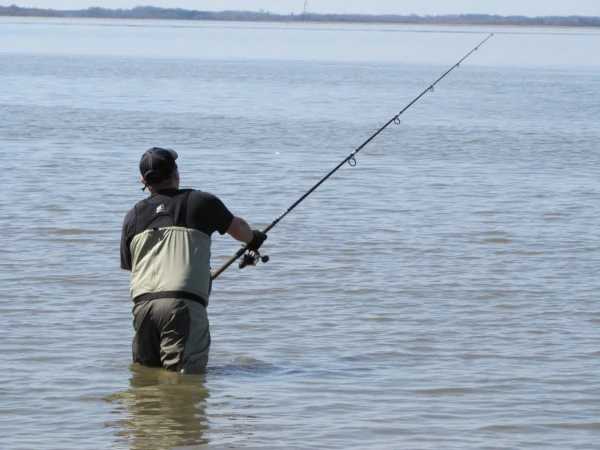
Tide and current play an especially important role when fishing the flats. At some locations, you could bomb a hero cast and you'd be lucky to reach 4 to 6 foot water depths. For this reason, I always plan my trips around high tide. Two to three hours before until two to three hours after high water usually provide the best action. Make sure to bring a couple dozen bloodworms because chances are you'll be catching a mixed bag of catfish, white perch and small stripers while your waiting for that cow to come by.
Recommended Gear:
- Shimano Thunnus TU6000CI4 Spinning Ree
- Lamiglas XS 11 MS Graphite Surf & Jetty Spinning Rod
- Shimano Baitrunner 6000D Spinning Reel
- Lamiglas XS 10 MHS Graphite Surf & Jetty Spinning Rod